
LARNACA, CYPRUS
Larnaca, also spelt Larnaka, is a city on the southeast coast of Cyprus and the capital of the Larnaca District. With a district population of 155,000 in 2021, it is the third largest city in the country after Nicosia and Limassol.
Built on the ruins of Kition, an Ancient Greek city-state and the birthplace of Stoic philosopher Zeno of Citium, Larnaca is home to the Church of Saint Lazarus, Hala Sultan Tekke, the Kamares Aqueduct, Larnaca Castle, Larnaca District Archaeological Museum, and Pierides Museum. It attracts many visitors to its beaches, as well as to Finikoudes, the city's signature seafront promenade lined with palm trees. It gives its name to the country's primary airport, Larnaca International Airport, which is situated in the neighbouring village of Dromolaxia rather than Larnaca proper. It also has a seaport and a marina.
TRANSPORT INFO
How to get to Larnaca

Air
Larnaka has one of the two international airports of Cyprus, located right outside the city. The town is accessible by the 432-bus going from Larnaka to the city centre, for a price from €2 to €4.
Getting around in Larnaca
Taxi
There are 2 types of taxi services in Cyprus. The private taxi that we all know about. You can flag down these kinds of taxis in the street or order them to have them pick you up from your home or hotel and take you anywhere you wish. In Cyprus, there are also line taxis or shared taxis that run on a regular pre-arranged schedule during the day between the main areas and towns. Do not forget that you need to pay for the start, distance and waiting of the taxi!
DOREA recommends Valentinos Taxi +357 96 577 370

Car
Driving in Larnaca is generally considered easy, as there is usually little traffic and well-maintained roads that feature easy-to-follow signage, but you still may find it easier to avoid the city centre. There are a lot of parking facilities, whose prices may vary, but usually they won’t exceed €5 an hour. Keep in mind - the driving is on the left side – something to get used to!

Bus
https://www.publictransport.com.cy.
Intercity buses: these buses travel several times a day between the major resort towns and the capital of the island.
Cyprus Public Transport provides a number of buses going around Larnaka. Fares cost €2.40 per Single Route (night bus €4.20), €41.70 for a week and €83.40 for a month, for the whole district of Larnaka.
All the information concerning the ticket prices, the bus routes and schedules van be found here. There are different bus routes taking you across the old town, the port and the main parts of the city.
Tip: Ticket prices are less if you get a Plastic PERSONALISED Motion Bus Card. More infor can be found here.
Bicycle
The main bicycle lane goes along the sea all the way to the port, the Old Castle and the Mosque. You can rent a bike from any of the nextbike stations – all you need is to download an app!
Practical tips – Need to know
Language: Greek
Currency: EUR Euro
Time zone: GMT + 2
Country code: + 357
Voltage: 240 V
Electrical socket: British BS
Tourist Contacts:
+357 24 654 322
Internet Resources:
https://larnakaregion.com/larnaka/about
https://www.larnaka.org.cy/en/
General emergency number: 112
Explore city centre
Larnaka Castle
Located at the end of the Foinikoudes promenade, the Medieval Castle of Larnaka (also referred to as Larnaka Fort) is believed to have been built during the Middle Ages to protect the town’s harbour and later took its current form during Ottoman rule. After the Ottoman period, the British used the fort as a prison, and parts of it were connected to executions until 1948. Today, it remains an important reminder of Larnaka’s layered history. Admission: € 2.50. Opening hours: Mon - Fri: 08:00 - 17:00 / Sat - Sun: 09:30 - 17:00 (Winter hours 16/9 - 15/4) and Mon- Fri: 08:00 - 19:30 / Sat - Sun: 09:30 - 19:30 (Summer hours 16/4 - 15/9)
Flamingos & Salt Lake
Most famous for the flocks of thousands of vivid Greater Flamingos that frequent the lake during the winter season, Larnaka Salt Lake is a complex of four salt lakes, covering a surface area of 2.2 sq. km. The main lake, with its winding nature path and birdwatch tower, is known as 'Aliki'. This larger lake is then followed by lakes Orphani, Soros and Airport, stretching all the way to Pervolia, Meneou and Dromolaxia villages. Located near the old airport and the Hala Sultan Tekke mosque, the lake has huge ecological value and is considered to be one of the most important wetlands of Cyprus.
Agios Lazaros (Saint Lazarus)
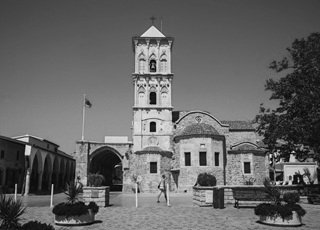
Located in the town centre, the Church of Agios Lazaros is one of the finest examples of Byzantine architecture in Cyprus. Built in the 9th century by Emperor Leo VI, it stands over the tomb of Saint Lazarus, who is believed to have lived in Larnaka after being resurrected by Jesus. The church was later restored in the 17th century, and its gold-covered iconostasis remains an impressive example of baroque woodcarving. Saint Lazarus is still deeply honoured in Larnaka, especially during the annual procession held before Easter. Opening hours: Mon-Sat 8.00 am - 6.30 pm, Sun 6.30 am - 12.30 am – 3.30 pm - 6.30 pm.
Hala Sultan Tekke Mosque
Located near Larnaka Salt Lake, Hala Sultan Tekke is one of the most important Muslim pilgrimage sites in Cyprus. The mosque is linked to Umm Haram, a relative of Prophet Muhammad, who is believed to have died at the site in 648 AD. It was renovated in 1816 and again in 2002, when archaeological excavations revealed that the area had been inhabited since Neolithic times. Today, the mosque remains an important place of worship and a significant historic landmark of Larnaka. Please note that a dress code is enforced, and visitors should dress modestly when entering the site. Opening hours: Mon-Sun 8.30 am - 5.00 pm, Fri 8.30 am - 1.00 pm – 3.00 pm - 5.00 pm.
Kamares: The Old Aqueduct of Larnaka
Located in the Kamares area of Larnaka, this beautiful 18th-century aqueduct is known for its distinctive stone arches. It was built in 1746 by Bekir Pasha to bring water to the town from a source about 10 km away. Although it was abandoned in 1939 and replaced by modern pipes, more than 20 arches still remain. Today, the aqueduct is an impressive open-air landmark, especially when illuminated at night.