
SEVILE, SPAIN
Seville is the capital and largest city of the Spanish autonomous community of Andalusia and the province of Seville. It is situated on the lower reaches of the River Guadalquivir, in the southwest of the Peninsula. Seville has a municipal population of about 686,741 as of 2024, and a metropolitan population of about 1.5 million, making it the largest city in Andalusia and the 5th-largest city in Spain. Its old town, with an area of 4 square kilometres, that contains a UNESCO World Heritage Site comprising three buildings: the Alcázar palace complex, the Cathedral and the General Archive of the Indies.
Seville was founded as the Roman city of Hispalis. Known as Ishbiliyah after the Islamic conquest in 711, Seville became the centre of the independent Taifa of Seville following the collapse of the Caliphate of Córdoba in the early 11th century; later it was ruled by Almoravids and Almohads until being incorporated into the Crown of Castile in 1248.
TRANSPORT INFO
How to get to Seville

Air
Seville has one international airport, only 10km from the city centre.
There are two ways to go to the city centre from the airport. The first one is by taxi, which can cost around 24€, or by bus, the AE Line (Especial Aeropuerto). The bus runs from 5:20 am to 1:00 am, and a single-way ticket costs 4€.
Getting around in Seville

Taxi
The taxis in Seville are common and usually affordable. They can take you from the airport to the city centre or for a ride within the city. For a short ride, the prices can vary between €7.00 and €8.00.

Car
Driving in Seville is a hassle, and most people prefer public transportation, bicycles, or just walking. If you still decide to drive, avoid the Old Town as it is for pedestrians only.

Bus
The TUSSAM is responsible for the bus network within the city. There are multiple bus lines going around the city, with some of them covering neighbourhoods that the subway doesn’t cover. A single-ride ticket costs €1.40, and for 3 days the price is of €10.
The details about the different lines can be found on the official website.
Metro
Seville also has a metro with only one line of 18 km covering 22 stations in total. It runs every day of the week, from 6.30 am to 11.00 pm or 2.00 am on the weekends. Even if it only counts one line, the prices can vary depending on the distance you travel. The cheapest ticket is at €1.35. You can also buy one for the whole day for the price of €4.50.
You can find the map of the subway, the ticket prices and the lines here.
Tram
Seville has a network of tramways called Metrocentro. It goes from Plaza Nueva to San Bernardo and passes by multiple tourist sites. It works from 6.00 am until 23.00 pm during the week and from 6.00 am to 2.00 pm during the weekends. A single way ticket costs €1.40, like the bus.
Bicycle
Seville is a bike-friendly city with 200 km of bike lanes and a public rental service called SEVICI, where you can rent a bike, a scooter or a Segway.
Practical tips – Need to know
Language: Spanish
Currency: EUR Euro
Time zone: GMT + 1
Country code: + 34
Voltage: 230 V
Electrical socket: Type F (Schuko)
Tourist Contacts:
+34 915 787 810
Internet Resources:
General emergency number: 112
Explore city centre
Plaza de España Square
It was built because of the Ibero-American Exhibition of 1929, held in Seville. Its creator was Aníbal González. He mixed a style inspired by the Renaissance with typical elements from the city: exposed brick, ceramics and wrought iron (worked by Domingo Prida). Its floor plan is semicircular. It is dominated by 2 towers, one on each side of the enclosed area, which frame the central building where the main rooms are. Between the two towers runs a network of galleries with an arcade of semicircular arches leading to exits in different parts of the square, where a fountain stands.
The Real Alcázar
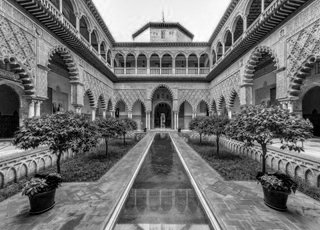
The Real Alcázar of Seville is a historic royal palace complex surrounded by walls and one of the city’s most important landmarks. Originally built on an Almohad site, it was transformed in the 14th century by Peter of Castile into a royal residence. The palace combines different architectural styles, with Mudejar and Renaissance elements being especially prominent. Its richly decorated rooms, courtyards, and gardens make it a must-see for visitors interested in history, architecture, and royal heritage. Opening hours: Mon-Sun: 9.30 am - 7.00 pm. Admission: General entrance €15, Reduction for +65 and students €8, Free for disabled and under 13.
Setas de Sevilla
The Metropol Parasol, known as “the Mushrooms of La Encarnación”, is the largest wooden structure in the world. A design by German architect Jürgen Mayer, it was inaugurated in 2011 and stands 29 metres tall. Composed of six large mushroom-shaped parasols, the structure offers fantastic views of Seville from its walkway viewpoint. The basement houses the Antiquarium museum, with relevant archaeological remains from the Roman era. The surrounding space includes a food market and an elevated plaza where different events are held. Opening hours: Mon-Sun 9.30 am - 11.45 pm. Admission: General €16 (discounts available).
General Archives of the Indies
The General Archive of the Indies in Seville is an important historic building originally designed by Juan de Herrera as a merchants’ exchange. It was later converted by King Carlos III into an archive for documents related to Spain’s overseas territories from the 15th to the 19th century. Today, it is one of the most significant document centres on the discovery and conquest of the New World. Opening hours: Tue-Sat 9.30 am - 4.30 pm, Sun and Bank Holidays 10.00 am - 1.30 pm. Closed on Monday. Free admission.
Plaza América
It is part of the urban artistic complex created for the Ibero-American Exposition of 1929. This square, the work of Aníbal González, located next to María Luisa Park, is surrounded by three palaces of different architectural styles that were built for the Ibero-American Exposition of 1929. The first, in neo-Gothic style, is the Pabellón Real. The second, in neo-Mudejar style, houses the Museum of Popular Arts and Customs, and the last, neo-Renaissance, is the Museo Arqueológico Provincial, which houses the Carambolo Treasure (one of the most important collections of ancient goldsmithing work).